

June 22, 2026
Westland supports on-farm innovation
At Westland we are totally committed to supporting projects that help our farming community address and mitigate challenges, while enhancing the region’s farming capability and strengthening the long-term resilience of our dairy supply. Each year we contribute $25,000 as well as staff resources to the West Coast Focus Farm Trust established nearly 20 years ago to support practical data-led projects that help West Coast farmers respond to on-farm issues. With Westland’s ongoing support, the Trust enables real-world trials that generate insights farmers can apply with confidence.
One such trial is testing the methane-emissions reduction technology on Stu and Debbie Bland’s West Coast farm to determine its effectiveness in local conditions. From our perspective this was critical.
The Blands’ farm is one of the West Coast focus farms and is “fairly typical” of many on the coast. They milk 240 cows on the farm located in the Upper Grey area.
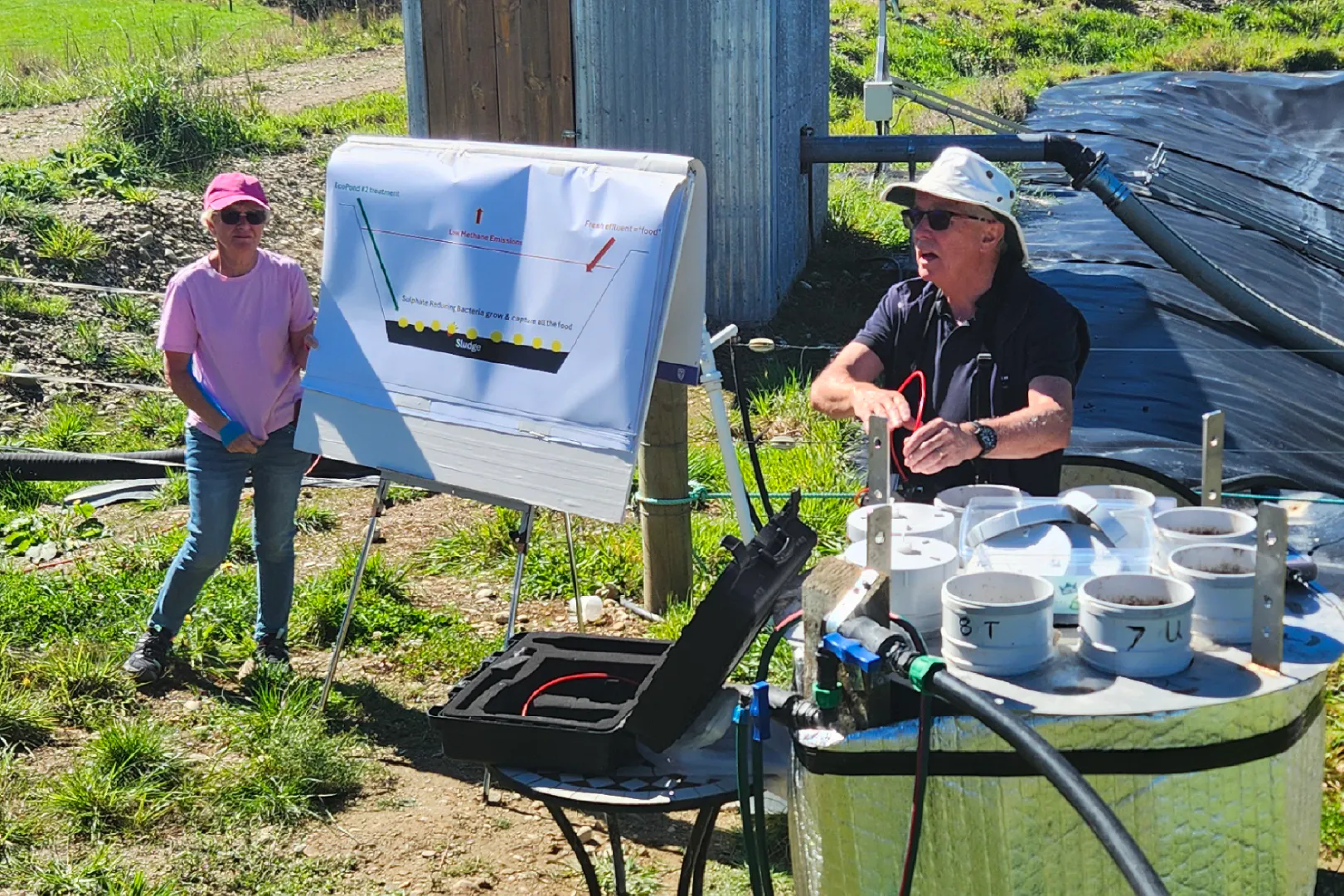
Stu Bland says they were keen to participate in the trial conducted over a 12-month period last year. “The trial involved installing a stainless-steel testing unit around 1.5m wide with 8 PVC pipes, four of which were for treated effluent and four for untreated. When they came to collect other data from my farm, they also compared the methane emissions from the treated and untreated effluent. It was simple.”
The Results
Westland Milk Products held a field day at the Blands’ farm earlier this year where Professor Cameron presented exciting results from trials throughout the country. “Firstly, we are grateful to the Blands for hosting the local trial which, in line with testing in other regions, showed the treatment is highly effective in its ability to reduce methane emissions from effluent ponds,” he says.
The process which involves adding iron sulphate and sulphuric acid to effluent, mimics natural processes and creates an unfavourable environment for methane-producing microorganisms (methanogens). The process boosts the growth of natural sulphate-reducing bacteria which compete with the methanogens for organic matter in the effluent.
The trial on the Bland’s farm reduced effluent methane emissions in the mid-80% range. “That’s phenomenal and the reduction in methane emissions achieved is highly significant,” says Professor Cameron, adding that the discovery of the additives’ effectiveness came about by chance when they were investigating their ability to clarify water in the effluent from washdowns so it could be reused.
“As part of that research process, we were looking at unintended consequences regarding methane and then found the big positive of the additives being highly effective in cutting emissions. It was another example of serendipity working in science.”
The new treatment system’s other benefits include slashing the amount of E. Coli in the treated effluent, reducing ammonia emissions, decreasing pond odour, and cutting phosphate leaching losses from effluent areas into waterways by up to 90 per cent. Trials have also shown reduced surface crusting on ponds.
EcoPond easy to operate
Project partner Ravensdown as well as Ministry of Primary Industries through the Centre for Climate Action on Agricultural Emissions are supporting the project, known commercially as EcoPond, in further developing the technology which has already evolved rapidly to become more practical. Information can be found at www.ecopond.co.nz.
Given the tangible results, it is easy to see why the farming community is excited about the technology which, if widely adopted on New Zealand farms, would not only help the country meet its target of reducing methane emissions by 10% by 2030 but also satisfy the expectations from premium overseas customers.
